
Ocean City Isn’t Spending Too Much on Projects. It’s Spending Too Much, Period.
Mayor Jay Gillian quoted the flattering parts of the S&P rating report. Here is what he left out — and why it matters.
At the April 23 City Council meeting concerning the mayor’s budget, and also earlier in the week in a blog post, Mayor Jay Gillian went on the defense to respond to campaign criticisms around budget mismanagement. It was clear those asking for more careful fiscal management had struck a nerve.
To discredit his critics, the mayor likes to cite a recent S&P Global report that says that Ocean City has “well-embedded budgeting practices” and a forward-looking capital plan that is protecting its most important revenue-producing asset—its homes. Sounds good, indeed.
But the mayor fails to mention another part of the same report that raised cautions about the city’s credit rating.
“The stable outlook reflects our view of the strength of Ocean City’s tax base, along with consistent financial performance that supports additional flexibility through available reserves and maintenance of levy bank capacity. We could lower the rating if reserves were to weaken, with no plan or ability to restore them. While unlikely, if debt were to materially increase beyond current expectations, we could also consider a rating action.”
—S&P Global Ratings (emphasis added)
Those are not the words of a PAC. They are not a blog post. They are not an “anonymous Facebook account,” as the mayor likes to say whenever he wants to dismiss a critic. They are a direct warning from the rating agency he asks residents to trust—and in the same report, S&P goes further and uses the word “elevated” to describe Ocean City’s debt service costs. Their word, not ours.
The Caution Lights Are Already Flashing
Debt payments are consuming a larger share of the budget than in any of our peer towns.
Reserves—basically the city’s savings account—are shrinking.
The city’s bond rating is tied for the lowest among comparable our affluent Cape May County oceanfront peers.
The reserves point is not hypothetical. Ocean City’s fund balance has dropped from $11,072,418 at the end of 2022 to $10,266,643 at the end of 2025—a decline of roughly $805,000, or 7.3%, across three consecutive fiscal years.
For context, the Government Finance Officers Association recommends a minimum general fund balance equal to two months of operating expenditures, or about 16.7%. Ocean City’s reserves sit at roughly 8.7% of its combined budget—barely half of the recommended minimum, and is trending downward.
It is not catastrophic—yet. But we are on the wrong path, and we can no longer afford to keep spending like drunken sailors, letting debt swallow the rest of the budget.
The Real Problem Isn’t the Projects — It’s Everything Else
From a rating agency standpoint, the city’s real estate is its greatest asset. It produces the majority of the city’s revenue, and that revenue is what ultimately protects bondholders.
So, to maintain a good credit rating, the rating agencies expect the city to protect that real estate—with pumping stations, retaining wall improvements, drainage, dune maintenance, and the like. Big capital needs, every year, forever.
When a city knows it has big, ongoing capital needs—and Ocean City does—it has two choices:
Run a tight day-to-day budget and pay for more of the capital projects in cash.
Or let everyday spending drift, and borrow the difference.
Under Gillian’s watch, Ocean City chose the second path, spending drift, year after year—until higher operating costs left less room to fund projects directly. So the city borrowed. And borrowed. And borrowed. Now the bill is coming due.
The Comparison with Other Cape May County Peer Towns
Ocean City now spends more than $1 of every $5 to pay off debt.
In Avalon, it is closer to $1 of every $9.
In Wildwood (a smaller shore town with a weaker tax base and a lower bond rating), it is closer to $1 of every $10.
That is not a rounding error. That is a structural problem. Debt does not just sit there—it crowds things out. Every dollar spent on past borrowing is a dollar that does not go to services, emergencies, or the next round of needed investments. And that borrowed dollar costs money. And when debt service climbs, the only way to cover the growing bill is to raise more revenue—which, at the municipal level, typically means raise taxes. It is a slow downward spiral. That is exactly what has happened in Ocean City, year after year.
Here is how Ocean City compares to the four other shore towns nearest to it in Cape May County. The number that tells the story is in the highlighted row.
2025 Cape May County Peer Town Budget Insights
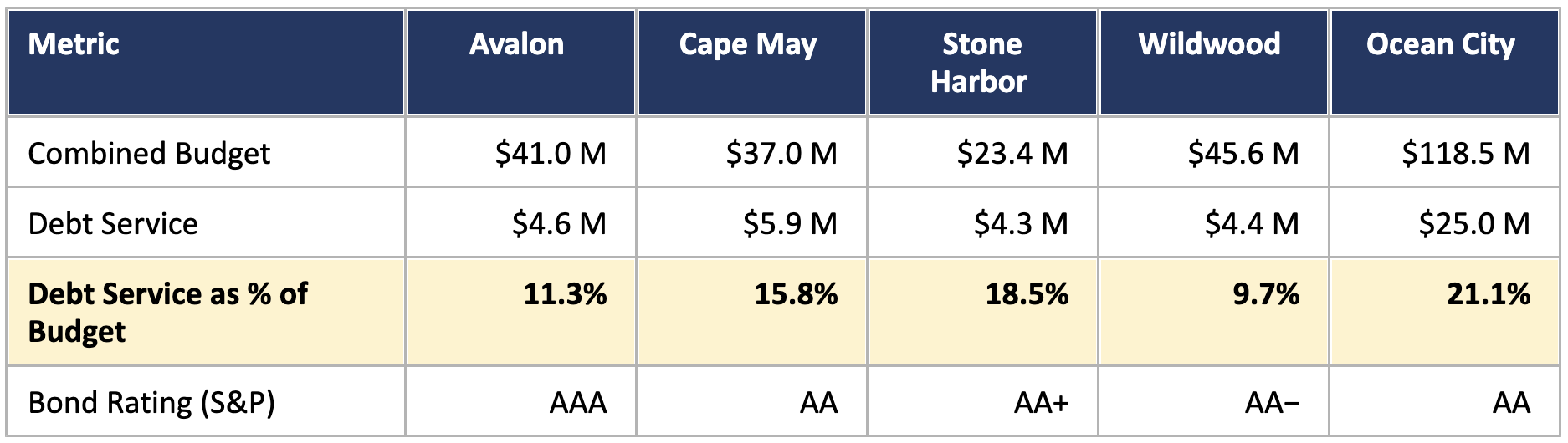
Sources: 2026 Proposed Municipal Budgets filed with the NJ Department of Community Affairs. Combined budget includes General Fund plus Beach and Tourism utilities where applicable; Water and Sewer utilities excluded for comparability across towns. Bond ratings: Avalon (S&P AAA, 2024); Stone Harbor (S&P AA+, raised 2020 and confirmed April 2026); Cape May (S&P AA, assigned August 2025); Wildwood (S&P AA−, November 2025); Ocean City (S&P AA). S&P Global rating report on Ocean City (full text available at jaygillian.com/media/SPglobal-OceanCityNJ.pdf).
The Excuses Don’t Hold Up
You will hear the same defense: Of course we borrow. We are a shore town. Everything is expensive.
Yet, these towns share the same fundamentals: seasonal populations that explode in summer, infrastructure that takes a beating, constant pressure to maintain beaches, roads, and public safety…. Same environment. Same pressures. Very different outcomes.
Ocean City stands apart not because it builds more—but because it chose the wrong way to pay for it.
Dismissing the Problem Won’t Fix It
Quoting the agreeable parts of a rating report—or dismissing critics to save face—is convenient. It is not leadership. It is avoidance, and ultimately, it is irresponsible.
Until those at the helm acknowledge that the problem starts with everyday spending—not capital projects—the conversation will keep missing the point.
Other towns are proving this can be done differently. They are building, maintaining, and protecting their assets too. They have just done the harder thing: kept their operating costs under control so the math still works. As we enter the budget season, City Council is well-advised to push for as much operating cost savings as is possible, and begin to reverse this troubling trend.
Ocean City residents are paying more, while the city has less room to maneuver when it matters most. This is a critical moment to choose another path—before it is too late.
Additional sources: Ocean City fund balance figures from the City’s Annual Financial Statements for fiscal years 2022 through 2025 (Sheet 21, Surplus — Current Fund). GFOA reserve benchmark per “Fund Balance Guidelines for the General Fund,” Government Finance Officers Association.